Problem and motivation
A forecast alone does not answer how much inventory to hold. Planning also depends on budget, stock, cost and replenishment assumptions.
Retail planners exploring how forecasting choices and operating assumptions affect inventory decisions.
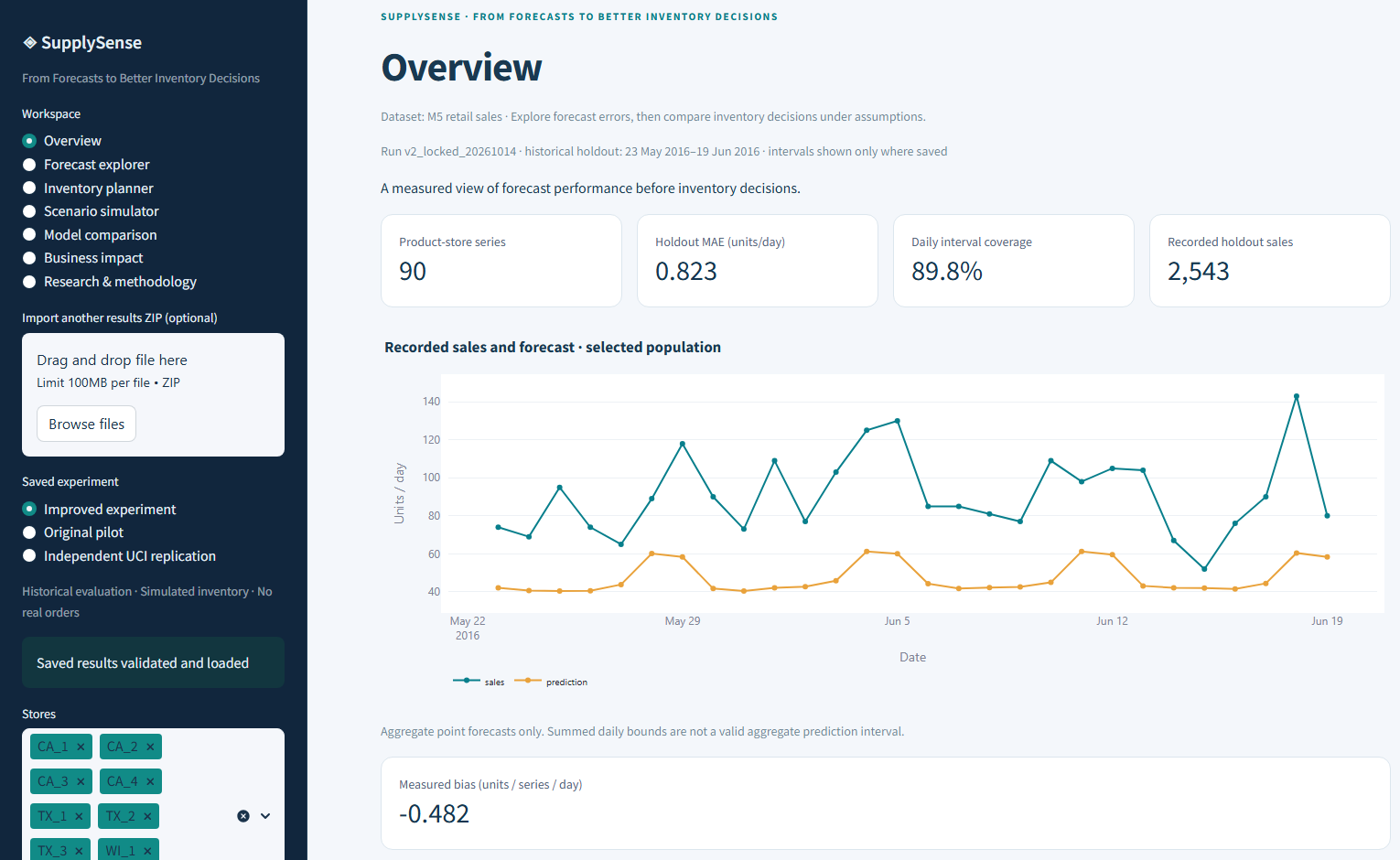 View full image ↗
Technical approach
Using public M5 retail data, the application combines forecasting experiments with a Streamlit dashboard for forecasts, inventory planning, scenarios, model comparison, business impact and methodology.
Implementation
Built a sales-forecasting and inventory-planning application with chronological evaluation, uncertainty bands, and configurable business simulations. Developed with AI coding assistance.
Evaluate in time order
Compare nine forecasting approaches on the same 28-day holdout from M5 sales history. Keeping the last four weeks out of training makes each method answer the same planning question.
Expose uncertainty and assumptions
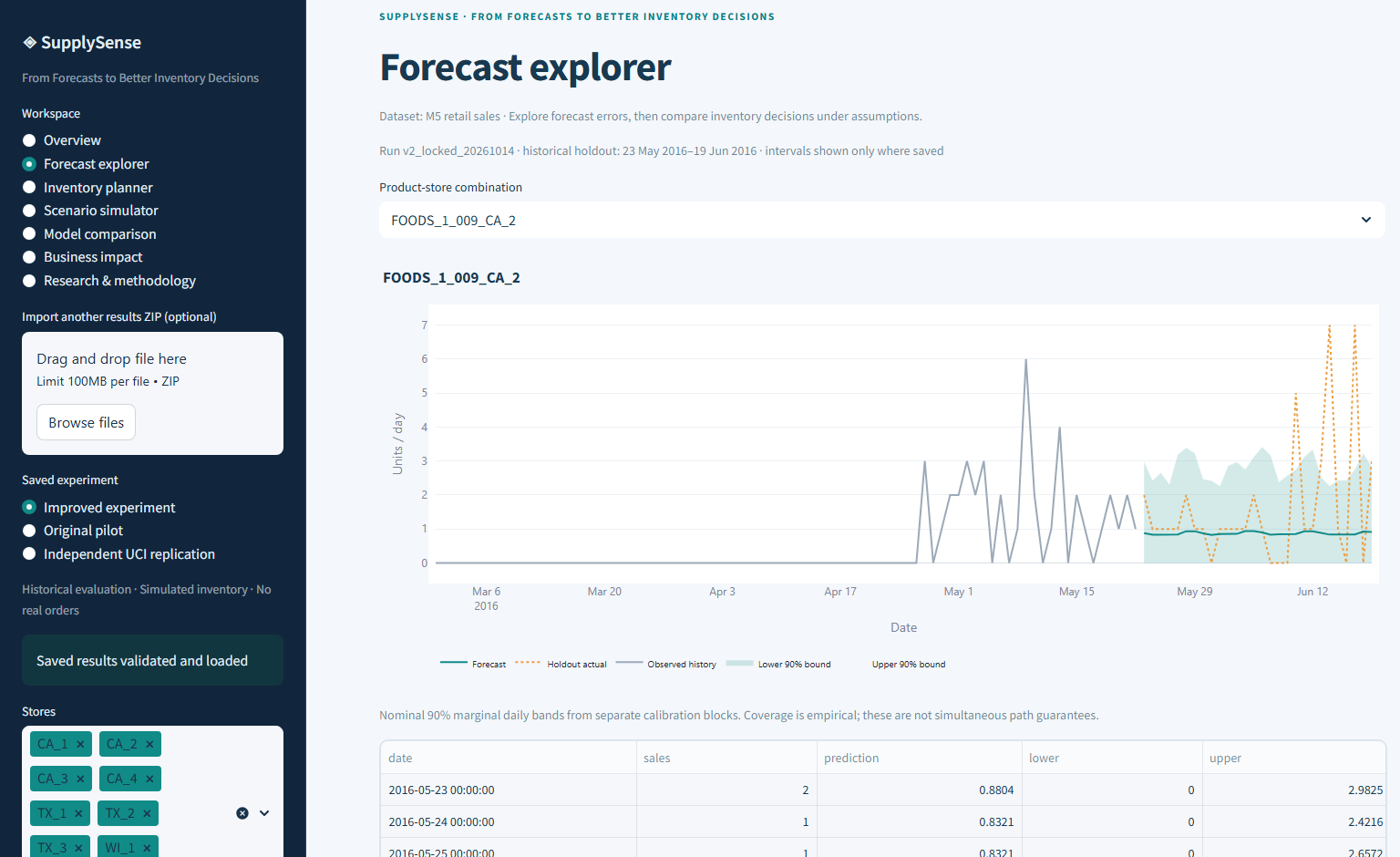
Show uncertainty bands and configurable planning inputs. Interval coverage describes how often observations fall inside an interval; it is not model accuracy.
Separate forecasting from business outcomes
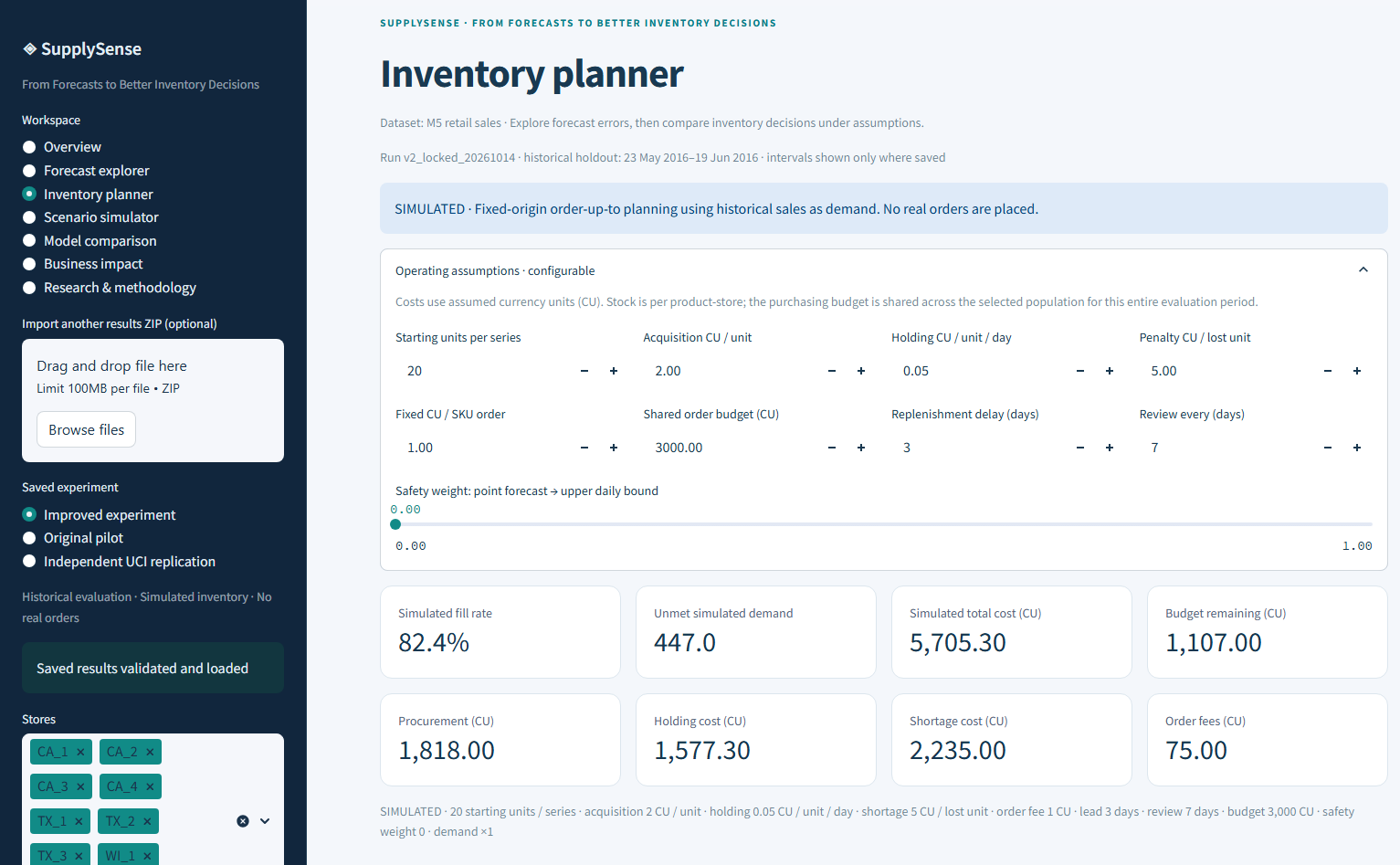
Compare model error and simulated inventory behaviour separately: the seasonal baseline produced better default simulated inventory outcomes than the model with lower MAE.
Forecast explorer with uncertainty intervals
 View full image ↗
Inventory planning with configurable simulation assumptions
 View full image ↗
Results and limitations
A working local application connects forecast comparison with inventory scenarios. The experiments illustrate why lower forecast error alone does not guarantee better simulated inventory decisions.
Inventory costs and service levels are simulations using historical sales as a demand proxy. They do not establish real business savings. No numerical performance results are presented here.
Current status
The original M5 experiment runs locally. A separate public Streamlit demo uses saved predictions from a UCI Online Retail subset; its results are not the M5 holdout results.
Technologies and source
- Python
- Streamlit
- Gradient boosting
- Public M5 data