Problem and motivation
Product feedback needs to be grouped, prioritised and translated into a clear specification while preserving the evidence and giving people control over scope.
Product builders turning public feedback or uploaded CSV records into a draft Product Requirements Document (PRD).
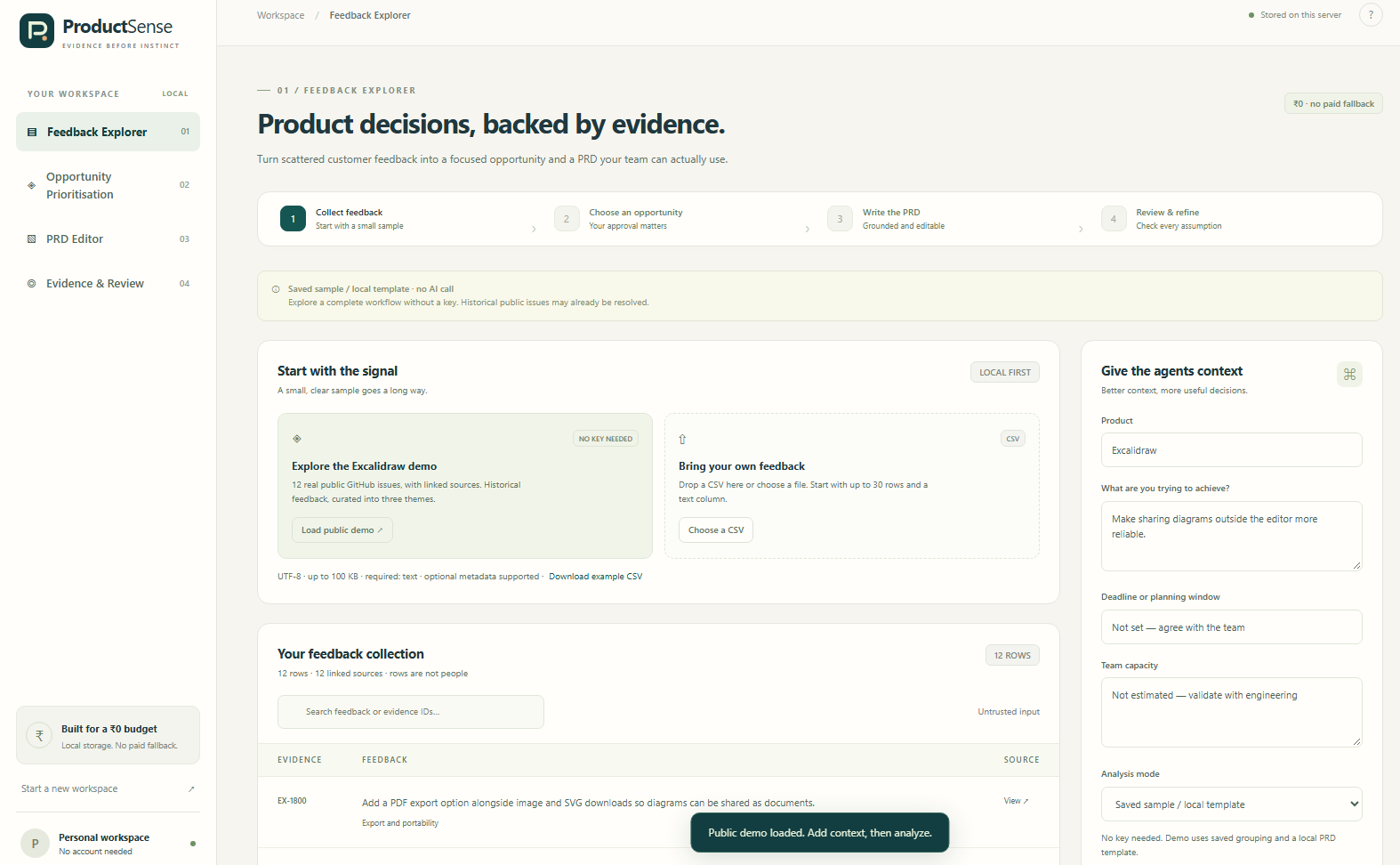 View full image ↗
Technical approach
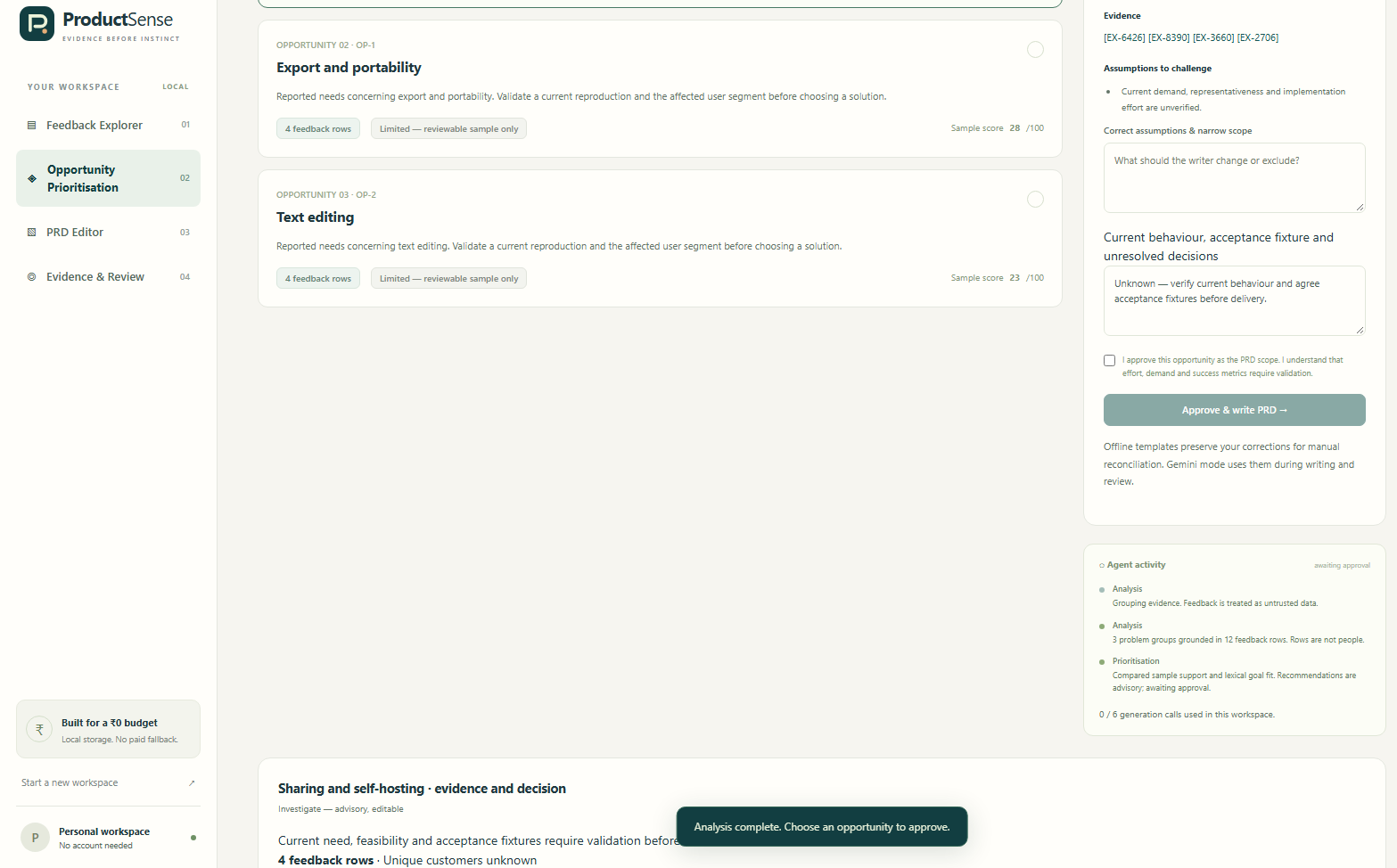
ProductSense groups feedback into editable opportunities. A product builder reviews the evidence and approves scope before drafting, then edits the PRD, compares revisions and exports the result.
Implementation
I built the feedback-to-PRD workflow with AI coding assistance. Saved checkpoints preserve scope decisions and drafts so a reviewer can return to a requirement and see how it changed.
Separate a report from an assumption
Before drafting, an evidence ledger separates observed feedback, user constraints and open questions. It flags potential duplicates and conflicts for review.
Make requirements inspectable
A traceability matrix links requirements to evidence IDs and acceptance criteria. Reviewers can compare versions, inspect missing citations or unsupported numbers, and export the matrix as CSV.
Keep evaluation cases separate by product
The new research dataset contains 22 cases across seven products. Development, validation and final splits use different products; the final comparison has not run.
Opportunity prioritisation and evidence review
 View full image ↗
Results and limitations
An exploratory study compared feedback-to-PRD workflows and inference resources: 28 evaluation slots included 18 unique PRDs. Follow-up tooling includes a 22-case, seven-product dataset and an offline test of evidence checks. The new live v3 comparison remains pending.
Evidence IDs and automated checks help review, but cannot establish that a citation supports a claim. Target checks missed wrong-but-valid citation swaps and negated requirements in an offline seeded-defect study; the checker was amended after earlier results. This is not a held-out real-world accuracy estimate. Limited same-model assessments do not establish agentic-workflow superiority.
Current status
Working local application with a saved offline demo. The new research protocol and tooling are available; optional cloud storage and job scaffolding are unfinished.
Research Manuscript
When Are Agentic Workflows Worth It? An Exploratory Evaluation of Feedback-to-PRD Generation and Inference Cost
Aditya Hambire.
An exploratory comparison of single-prompt, iterative single-agent and role/context workflows for feedback-to-PRD generation. The study examines completion, inference cost and evaluator validity; it does not establish a reliable PRD-quality advantage for agentic workflows. This linked earlier draft is not an accepted or published paper. A newer six-page draft remains local pending author-placeholder corrections.
View earlier exploratory manuscript (PDF) ↗ (opens in a new tab)Technologies and source
- Python
- FastAPI
- LangGraph
- Gemini (optional)
- Browser interface
- Markdown, Word & CSV exports