Problem and motivation
A single average treatment effect can obscure variation across patient populations. The project explores how causal analysis can help examine that variation and communicate its assumptions.
Researchers and readers interpreting differences in treatment effects across patient groups.
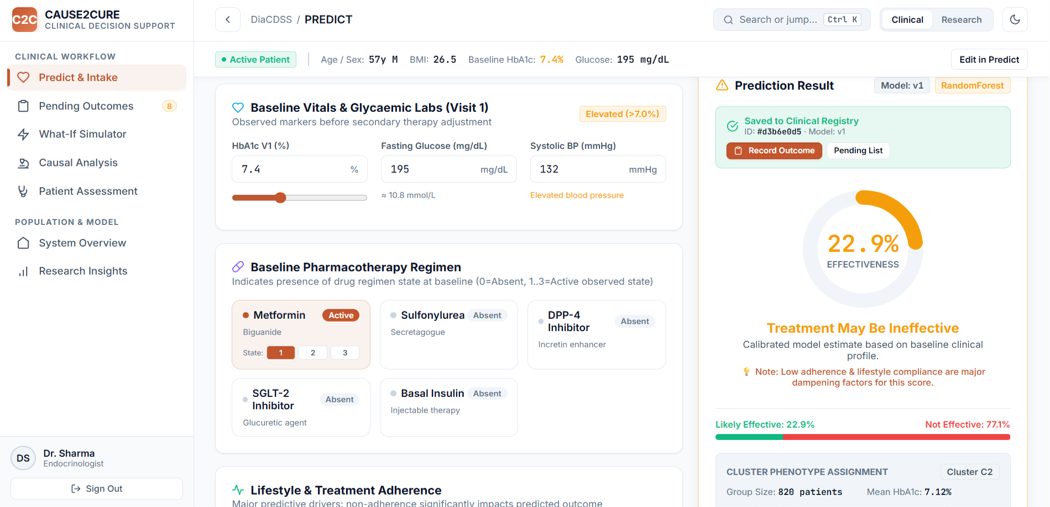 View full image ↗
Technical approach
The team studied synthetic Type 2 diabetes records. Predictive models, patient groups and SHAP explanations support inspection of model behaviour; separate observational estimates explore treatment effects across groups.
My contribution
My primary contributions were literature review, comparison of prior research, identifying limitations and manuscript preparation. I also contributed to model development and evaluation as part of the team.
Look beyond a single average
Examine variations across patient populations through treatment-effect and counterfactual analysis.
Make interpretation part of the work
Bring the analytical findings into a dashboard and manuscript, with attention to bias and assumptions.
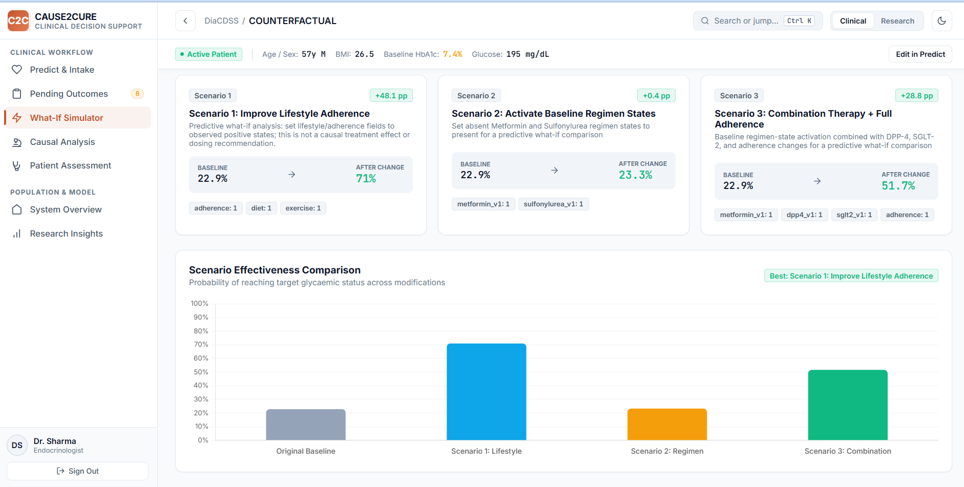
What-if scenarios and prediction comparisons
 View full image ↗
Research application landing and sign-in interface
 View full image ↗
Results and limitations
The team presented Cause2Cure at ISRSD 2026. Springer Nature proceedings publication in progress.
Changing an input in a predictive what-if view shows how the model responds. It does not identify what would happen to a patient. All experiments used synthetic data; the dashboard is not clinically validated.
Current status
Major final-year engineering research project. Conference presentation completed; proceedings publication in progress.
Research Manuscript
Cause2Cure: Bridging Prediction and Counterfactual Reasoning for Drug Effectiveness Analysis Across Patient Groups
Aditya Hambire, Shubham Jainapur, Kaustubh Jadhav, Devanand Bathe.
Accepted & Presented at ISRSD 2026
Springer Nature conference proceedings — publication in progress
A research framework combining treatment-response prediction, patient grouping and predictive what-if analysis to explore variation in drug effectiveness across patient groups.
View Research Paper (PDF) ↗ (opens in a new tab)Technologies and source
- Causal machine learning
- Counterfactual analysis
- Data visualisation